
Daggett County Court Records After a Jail Arrest
A Daggett County arrest starts with law enforcement, not the court. The sheriff or another agency may create an incident report, arrest report, citation, booking information, and related custody records. The court case begins when the prosecutor reviews the law-enforcement report and files charges, or when a citation or complaint is processed by the appropriate court.
In Daggett County, prosecution is handled by the Daggett County Attorney's Office. The current County Attorney is Kent Snider. Lower-level Class B and C misdemeanors and infractions are handled by Daggett County Justice Court. District-level criminal matters route through 8th District Court. The arrest charge listed in a police or booking record is not necessarily the same as the final court charge.
For custody, booking, and sheriff report detail, use Daggett County jail inmate records. For booking photos, use Daggett County jail mugshots. For court records after an arrest, focus on Xchange, MyCase, the Justice Court, the 8th District Court, and County Attorney routing.
The county attorney page screenshot below comes from the official Daggett County Attorney's Office page.
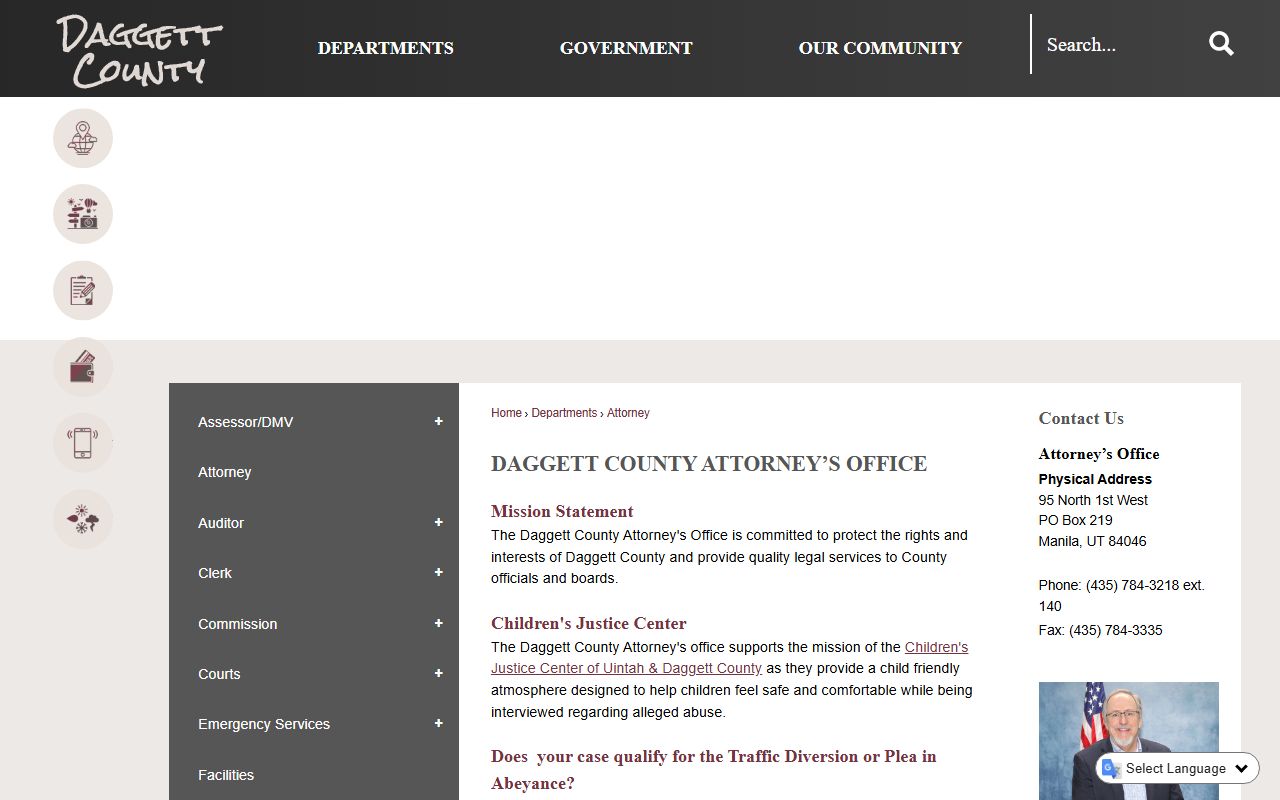
That office is relevant because prosecutor filing decisions turn an arrest report into the court case record that appears in public court systems when the record is not restricted.
How To Find Court Records After a Daggett County Arrest
Utah Courts Xchange is the statewide public case-search path for summary case information entered into CORIS by court staff. It is not a live jail-custody tool. It may show party names, party addresses if available, assigned judges, attorneys of record, filed documents, hearings, judgments, and outcomes. Public district court document images may be available for purchase, but sealed, expunged, juvenile delinquency, child welfare, termination of parental rights, and other nonpublic records are not displayed.
- Collect the defendant's full legal name, approximate arrest or citation date, date of birth if known, and any citation, case, or report number.
- Ask the sheriff for the police report or booking record if the court search needs arrest context or a case/report number.
- Search Utah Xchange by last name, using a wildcard asterisk when the spelling or name variation is uncertain.
- Check Daggett County Justice Court for Class B and C misdemeanors, infractions, citations, missed court, payment issues, and bench warrants.
- Check Daggett County 8th District Court for felony, district-level, or other district court criminal matters.
- Use MyCase if you are a party and need account access to your own case. MyCase requires an email address, case number, and government ID.
- Contact the County Attorney's Office for prosecutor-specific diversion or plea-in-abeyance questions, not for routine court clerk record copies.
Xchange Search Fields for Court Records After an Arrest
Utah Courts help explains that name searches are exact unless a wildcard is used. A last name followed by an asterisk can catch variations, and the first few letters of a first name followed by an asterisk can help when the entered name is uncertain. Xchange help also notes a maximum of 500 results in a single search.
| Field Label | Type | Required | Options / Format Notes |
|---|---|---|---|
| First Name | Text | Usually optional with last name | Use wildcard after first letters when uncertain, such as John*. |
| Last Name | Text | Usually needed for name search | Use wildcard for variations, such as William*. |
| Business Name | Text | Optional | Use the business name in the last-name field with wildcard if needed. |
| Case Number | Text | Optional | Best for precise lookup if the citation or court case number is known. |
| Court / Location | Dropdown or filter | Interface-dependent | Narrow to the court or county location when available. |
| Search | Button | N/A | Runs the query; refine if too many records are returned. |
How Charges Get Filed After an Arrest
Booking allegations and filed charges answer different questions. A sheriff record may show why a person was arrested or cited. A court record shows what the prosecutor or court filed and how the case progressed. The County Attorney may file a complaint or information, amend or reduce charges, decline charges, dismiss a case, or use diversion or plea in abeyance where the official program allows it.
| Complaint | Information | Indictment | |
|---|---|---|---|
| Filed By | Officer or prosecutor, depending on case type | Prosecutor | Grand jury |
| Common For | Citations, misdemeanors, and many initial criminal filings | Many felony or prosecutor-filed cases | Serious felony matters, less common in routine local cases |
| Starts | A court case or formal accusation | A prosecutor-filed court case | A court case based on grand-jury action |
| Daggett Routing | Justice Court or District Court depending on charge level | County Attorney and District Court when applicable | Federal or state channels if used |
Justice Court and 8th District Court Records After Arrest
Daggett County Justice Court hears Class B and C misdemeanors, infractions, and small claims. The court generally meets the second Wednesday and Thursday of each month, subject to change, and now meets online through Webex while in-person attendance remains available. The Justice Court office is at 95 N 1st West, PO Box 219, Manila, UT 84046. Its listed phone is 435-784-3216, with a phone-outage notice directing callers to 435-343-9001 while that notice is active.
Daggett County 8th District Court is held one day per month, with a 9:30 a.m. start time unless otherwise noted. The local 8th District Court page lists a public court computer at the Clerk's Office, 95 N 1st W, Manila, UT. The clerk phone is 435-784-3154, and the clerk office hours are Monday through Friday, 9 a.m. to 5 p.m., closed holidays.
Charge Status in Court Records After an Arrest
Charge status can change after the initial arrest. A charge may be filed, amended, reduced, dismissed, held in abeyance, or resolved by plea, verdict, diversion, or payment if the case type allows. Court records should be read by event date and charge line because old arrest allegations can remain in a sheriff report while the active court case looks different.
| Status | What It Means |
|---|---|
| Pending | The case or charge has not reached final disposition. |
| Amended | The prosecutor or court changed the charge, wording, level, or count. |
| Reduced | The charge level or offense was lowered, often through negotiation or amended filing. |
| Dismissed | The charge or case was ended without a conviction on that count. |
| Diversion | For eligible matters, successful completion may lead to dismissal under the County Attorney's program terms. |
| Plea in Abeyance | A guilty plea is held without conviction entry if conditions are completed; failure can lead to sentence entry. |
| Convicted | A guilty plea, verdict, or other disposition resulted in conviction on that charge. |
Bail, Citation Payments, and Release After an Arrest
Daggett County Justice Court says it accepts bail for citations received. Payments can be made in person at 95 North 1st West in Manila, by mail, or online through the county justice payment link. Payment plans of no less than $50 per month can be arranged at the court office. The court accepts checks to Daggett County Justice Court, cashier's checks, money orders, and Discover, Mastercard, or Visa with a $3 service fee.
Warrants are different. The Justice Court page says warrants must be paid in full with guaranteed funds to be recalled. The closed jail also means there is no current Daggett 24-hour jail bond counter published in official sources. For a custody-related release question, call the sheriff or the actual holding agency. Paying one court amount may not clear another county warrant, a state parole hold, a federal hold, an ICE detainer, or a no-bond court order.
| Release or Payment Concept | Daggett-Specific Meaning |
|---|---|
| Citation bail/payment | Justice Court accepts bail for citations and provides in-person, mail, online, and payment-plan options. |
| Warrant payment | Justice Court says warrants require full payment with guaranteed funds to be recalled. |
| Payment plan | Plans of no less than $50 per month can be arranged at the court office if eligible. |
| Jail bond counter | No current Daggett jail bond desk was located because the county jail is closed. |
| Hold or detainer | Confirm with the holding agency; one payment may not release a person from all holds. |
Warrants That Lead to Court Records and Arrest
No official Daggett County sheriff active warrant list or public warrant-search portal was located. The Justice Court page is the main local source for warrant detail. It warns that missing court is serious and can result in an arrest warrant. It also says the court usually gives 24 to 48 hours to contact the court and reschedule before issuing a bench warrant.
A bench warrant usually comes from missed court, failure to pay, or failure to comply. An arrest warrant follows probable cause or the charging process. A search warrant authorizes a search and does not by itself create a booking record. A fugitive or hold warrant may come from another jurisdiction. For court-issued warrants, contact the issuing court. For arrest records after a warrant is served, contact the sheriff. VINE is a notification tool, not a warrant-clearing system.
Charges vs. Convictions in Court Records After Arrest
An arrest, a charge, and a conviction are not the same thing. Public court records may show accusations before there is any final result. Read the disposition and each charge status before treating a record as a conviction record.
| Charge | Conviction | |
|---|---|---|
| Stage | An accusation filed in court after arrest, citation, or prosecutor review. | A final guilty plea, verdict, or judgment on a charge. |
| Proof Standard | Based on probable cause or filed allegations. | Requires a plea, verdict, or legal finding sufficient for conviction. |
| Can Change? | Yes. It may be amended, reduced, dismissed, or held in abeyance. | Can be appealed, set aside, or later affected by expungement if eligible. |
| Public Meaning | Shows that a case was filed, not that the person was found guilty. | Shows a resolved criminal finding unless sealed, expunged, or otherwise restricted. |
Diversion and Plea in Abeyance After an Arrest
The Daggett County Attorney page describes traffic diversion agreements for certain first-time traffic offenses and plea-in-abeyance agreements for some first-time misdemeanor drug offenses. Diversion can result in dismissal after conditions are completed, with the office describing successful traffic diversion as if charges were never filed. Plea in abeyance involves a guilty plea while the court does not enter conviction; successful completion leads to dismissal, while failure allows the court to enter the guilty plea and impose the original sentence.
Eligibility is not automatic. The County Attorney's Office reviews applications, decides whether a person qualifies, and sends an agreement with terms. The Justice Court page also warns not to contact the court when trying to reach County Attorney Kent Snider because the court can only provide the same prosecutor contact information.
Sealed and Expunged Court Records After an Arrest
Utah court and public-record systems do not display every record. Xchange excludes sealed and expunged cases and other nonpublic matters. The Justice Court page cites Utah Code 78A-2-229 for private, protected, or sealed documents received because of litigation or pro se representation, warning that those documents are confidential and may not be distributed without court authorization.
| Sealed | Expunged | |
|---|---|---|
| Public Visibility | Hidden from ordinary public inspection. | Restricted under Utah expungement law and removed from ordinary public access. |
| Related Law | Court sealing rules and confidentiality statutes can limit access. | Utah Code 77-40a-101 defines expungement concepts. |
| Eligibility | Depends on record type and court order. | Eligibility and certificate requirements can involve Utah Code 77-40a-303. |
| Practical Effect | Public searchers may see no case or limited case information. | Xchange and ordinary public systems should not show expunged cases. |
Background Check Considerations
Casual public court lookup is not the same as an FCRA-compliant background check. Court records after an arrest may be incomplete, sealed, expunged, dismissed, amended, or delayed. Verify case details with Utah Courts or the clerk before relying on a record for any important decision.
Important: This site is not a consumer reporting agency and court or arrest information here may not be used for FCRA-covered screening decisions.